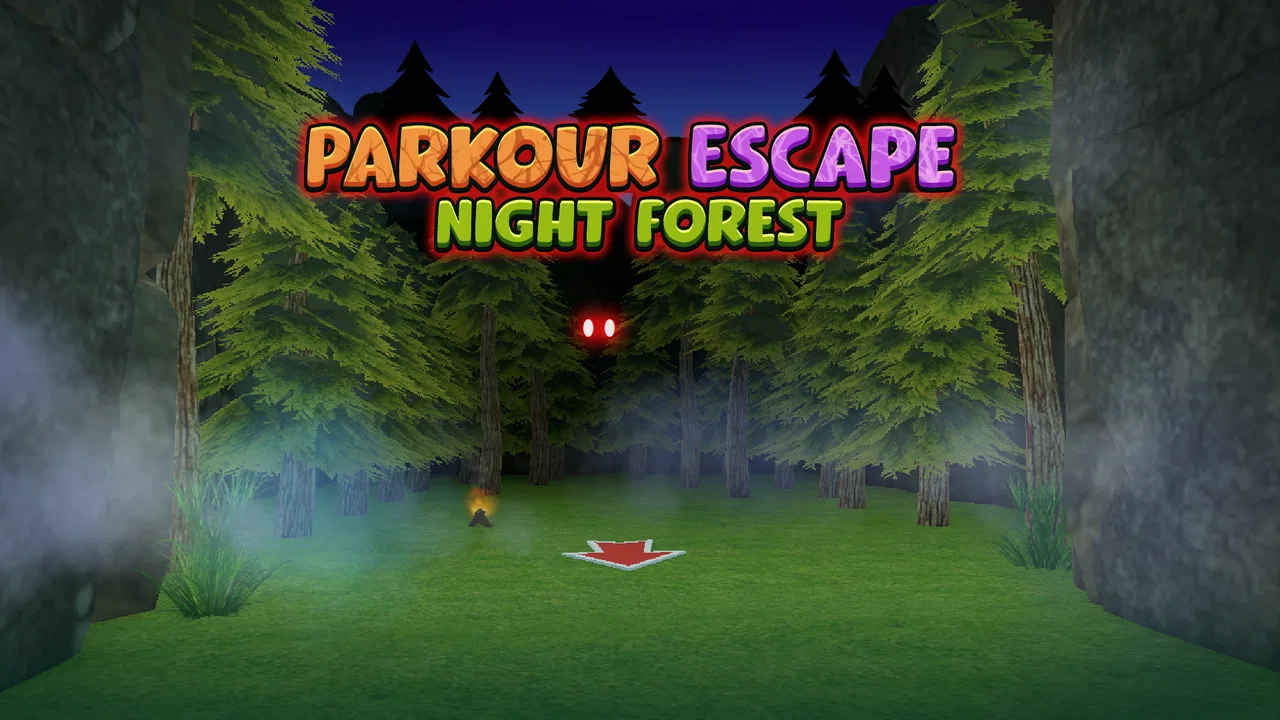
Parkour Escape: Night Forest
- 3.2
- Rating
- 1.00M
- Installs
- Free
- Price
 Analysis by App-foxy
Some adventure games ask me to explore at my own pace. Parkour Escape: Night Forest takes the opposite approach: it puts me in a threatening woodland, gives me movement challenges, and makes survival the immediate goal. After spending time with it, I see a compact, tension-focused experience aimed at players who enjoy dark atmosphere, quick reactions, and the simple satisfaction of reaching safety while something frightening is nearby.
The game comes from Blox Global and is free to download, although optional in-app purchases range from $0.99 to $19.99 per item. It is listed for Everyone, works on Android 6.0 and newer, and has reached over one million installs. Those details make it easy to try, but the average score of 2.9 from around 361 ratings also tells me that the experience is not going to suit every player. My impression is similarly mixed: the central idea is immediately understandable, while the long-term appeal depends heavily on how much repetition and pressure you are willing to accept.
A closer look at the current night-forest experience
I’ll focus on how the current forest setting shapes each attempt, then point toward the practical choices that can make a short run feel more deliberate. In my experience, the useful distinction is whether I’m learning to read the route or merely reacting to the chase; keeping that in mind makes it easier to judge what to try next.
You May Also Like

 Blood Strike: 2.5 Anniversary
Blood Strike’s Loadouts Turn Every Drop Into a Tactical Gamble
A close look at Blood Strike’s custom loadouts: how fast access to signature weapons reshapes its battle royale rhythm, rewards preparation, and narrows the gap between fights.

 Pandora - Music & Podcasts
Pandora’s Music Is Easy to Start, but Harder to Recover
Pandora’s strength is its low-effort path from a seed to a station. Its weak spot is how much confidence it asks you to place in connection, setup, and quiet recovery.

 8 Ball Pool
 Is Built on Rivalries, Rematches, and Routine
A close look at the rivalries, rematches, shared routines, and unanswered safety questions that turn a quick pool match into a persistent mobile community.

 Samsung Music
’s Quiet Strength Is Playing What You Already Own
Its reach comes less from spectacle than from dependable access to a personal library. That simplicity is both the app’s strongest retention engine and its ceiling.

 AccuWeather: Weather Radar
AccuWeather Review: A Quick, Clear Forecast for Everyday Decisions
For everyday plans, the best forecast is the one you can understand quickly. AccuWeather makes rain timing, radar, and local conditions easy to act on, with a few trade-offs.

 Hill Climb Racing
Why Hill Climb Racing Still Turns Crashes Into One More Run
A tiny car, a bumpy hill and one more upgrade: Hill Climb Racing keeps resurfacing because its simple chaos makes every near-miss feel personal.
More From Our News Desk
View All News


Movement is the main reason to play
The appeal here is not a complicated story or a large collection of systems. The attraction is the act of moving through a dangerous environment without losing momentum. Parkour-style play works best when I can read the space quickly, choose a route, and react when the situation changes. A dark forest is a useful setting for that kind of challenge because visibility itself becomes part of the pressure. Trees, shadows, narrow passages, and sudden threats make a familiar jump feel less comfortable than it would in a bright training course.
I like that the concept is easy to understand before playing. You are not asked to learn a long backstory or manage a large inventory before the action begins. The objective is direct: keep moving, avoid the monsters, and find a way out. That clarity makes it suitable for short sessions, especially when I want something more active than a puzzle game but less demanding than a lengthy role-playing adventure.
The trade-off is that a straightforward premise leaves the controls and level design carrying most of the experience. If movement feels responsive, even a modest route can create suspense. If jumps feel imprecise or the environment becomes too repetitive, the dark setting cannot solve the problem by itself. This is the first thing I would pay attention to during a trial session, because it matters more here than the size of the download or the number of menu options.
How the fear and parkour work together
The monsters are not just decoration. Their presence changes how I approach movement. In a normal obstacle course, I can study a jump until I feel comfortable. In this game, the pressure of being pursued encourages faster decisions. That creates a useful tension between caution and speed: taking a moment to understand the route may reduce mistakes, but hesitation can also make the threat feel closer.
One practical technique is to treat each section of the forest as a route-reading exercise rather than sprinting blindly from the start. I find it more effective to look for the next safe landing or opening before committing to a jump. This does not remove the fear, but it turns panic into a repeatable process. Players who enjoy improving through trial and error will probably get more from that approach than players who expect every attempt to feel fair and predictable immediately.
Another small but important point is session length. A chase-focused game can become tiring when played continuously, particularly if repeated failures come from the same obstacle. I would use it in short bursts, then take a break when I notice myself rushing inputs. That is not a criticism of the concept; it is a sensible way to preserve the tension instead of allowing it to become frustration.
What the current version indicates
The current version is 1.12, while the game was released on April 8, 2026. I read that as a product that has already moved beyond its first public build, but not as proof that every rough edge has been resolved. A version number can show ongoing development, yet it cannot tell me whether the most important improvements concern controls, enemy behavior, level variety, performance, or presentation.
For an existing player, the practical expectation should be modest but positive: the game is in a state where trying the current build makes more sense than judging it only by an early impression. At the same time, I would not assume that an update automatically changes the core experience. If you disliked the basic chase-and-escape structure, a newer version is unlikely to turn it into a story-heavy adventure or a broad exploration game.
The release timing also matters when interpreting the overall reception. A rating of 2.9 is a warning to approach carefully, not a final verdict on your personal experience. With only a small number of written reviews compared with the broader rating total, I would place more weight on your first few minutes of control response and pacing than on the score alone. The game is free to start, so that initial hands-on test is more useful than guessing from a number.
Who will enjoy it most
I would recommend this adventure to players who like compact horror challenges, obstacle courses with a threatening twist, and games that reward repeated attempts. It is particularly suitable for someone who wants a clear objective rather than a large world filled with optional tasks. If you enjoy learning a route, reacting under pressure, and gradually becoming less nervous in the same environment, the format has a good chance of working for you.
It may also suit younger players who are comfortable with spooky imagery but do not want graphic or mature content, since the listed age classification is Everyone. I would still consider the individual player's sensitivity to dark forests and monster chases, because an age label does not guarantee that the atmosphere will feel comfortable for every child.
I would skip it if your ideal adventure game is built around dialogue, character development, crafting, or relaxed sightseeing. It is also not my first choice for someone who dislikes restarting after mistakes. The central loop depends on pressure, and that pressure is precisely what some players will find exciting while others find exhausting.
A realistic everyday use case
Imagine having ten minutes before leaving for work or school. You want a game that can begin quickly, give you an immediate goal, and does not require remembering a complicated plot. This is where the title makes sense. I can open it, focus on one escape attempt, and stop without feeling that I have abandoned a major story chapter. The same applies to a short evening break when I want a little suspense but do not have the energy for a long campaign.
For a longer commute or a quiet weekend session, the question changes. Repetition becomes more noticeable, and I would want enough variety in routes and threats to keep the forest from feeling like the same challenge repeated. That is the point at which players should decide whether the movement itself remains enjoyable. If the answer is yes, the simple structure can stay engaging. If the answer is no, additional playtime will probably expose the limitation rather than fix it.
Three useful habits that improve the experience
My first tip is to separate route learning from speed. On an early attempt, I would concentrate on identifying where the next movement decision happens instead of trying to escape as quickly as possible. This makes failures more informative. Once the path feels familiar, speed becomes a meaningful goal rather than a source of random mistakes.
Second, I would avoid treating every monster encounter as a reason to change direction immediately. Panic can lead to a worse jump or a dead end. When the environment allows it, keeping a planned line is often more valuable than making a dramatic last-second turn. That is a general strategy, but it is especially relevant here because the dark setting makes rushed decisions harder to evaluate.
Third, I would be careful with optional spending. Since the game is free and individual purchases can cost up to $19.99, I would play enough of the basic loop to decide whether I genuinely enjoy it before buying anything. A purchase may make sense to someone who wants to support continued development or enhance their sessions, but it cannot replace satisfying movement. If the controls or repetition already bother you, spending more is unlikely to solve the underlying issue.
Where the game still feels limited
The biggest potential weakness is narrowness. A focused premise is valuable, but it also means every weakness is easy to notice. There is less room for a weak section to hide behind dialogue, puzzles, exploration, or character customization. When the main activity is escaping through a forest, the quality of the route, the clarity of hazards, and the feel of movement determine almost everything.
The atmosphere can create suspense, but darkness can also reduce readability. A setting that is too dim may make a failed jump feel like a visibility problem rather than a skill problem. I prefer when a horror game makes me uncertain about danger without making the intended path impossible to read. Players with visual discomfort or a strong preference for bright, clearly marked environments should keep that trade-off in mind.
There is also a difference between challenge and interruption. A monster is effective when it forces me to rethink timing or positioning. It is less satisfying when it simply appears to invalidate progress without giving me a useful lesson for the next attempt. I would judge the game by whether failures teach me something. If I can identify the mistake and adjust, the pressure feels earned. If I cannot, the same tension may quickly become annoyance.
How it compares with familiar alternatives
Compared with a traditional platform adventure, this game places more emphasis on pursuit and atmosphere than on broad exploration. A conventional platformer may give me bright visual cues, collectible routes, and carefully staged jumps. Here, the forest and the monsters make the same movement decisions feel more urgent, but the experience is less relaxing and potentially less readable.
Compared with a larger survival-horror game, it is much more immediate. I am not looking for a complex narrative arc or spending long periods managing resources. That makes it easier to pick up, but it also means there is less emotional context behind the danger. The fear comes mainly from the chase and the environment, not from a deep cast of characters or a slowly unfolding mystery.
Compared with endless-runner games, the parkour idea offers a stronger sense of place. I am not simply reacting to an endless stream of obstacles in a neutral lane. The night forest gives the escape a recognizable mood. The downside is that a runner often feels effortless to start, while a parkour challenge can demand more patience when a route requires repeated practice.
For me, the best alternative depends on the desired mood. I would choose this title over a calm exploration game when I want immediate pressure. I would choose a story-driven horror adventure when I want atmosphere supported by narrative. I would choose a polished platformer when precise movement and fair visual communication matter more to me than being chased through a frightening setting.
What current users should watch for
Players already installed should watch how updates affect the parts that matter most: movement consistency, route variety, enemy behavior, and the balance between darkness and visibility. Those are the areas most likely to change how the game feels, even if the basic objective remains the same. I would also note whether a new version improves the first-session experience for newcomers without making familiar routes less satisfying for returning players.
It is useful to keep expectations grounded. Version 1.12 suggests an evolving product, but I would treat future improvements as possibilities rather than promises. The safest approach is to enjoy what works in the current build and reassess after an update instead of buying something based on hoped-for changes. This is especially important when optional purchases are available: spend because the present experience already earns your confidence, not because you expect a future build to transform it.
New players should begin with a short test focused on three questions. Do the controls respond in a way that feels predictable? Can you understand why a failed attempt went wrong? Does the forest atmosphere make repeated attempts more exciting rather than more irritating? Those answers will tell you more than the install count or the store score. The game has passed one million installs, but popularity does not guarantee that its particular style of tension matches your preferences.
My final recommendation
I see Parkour Escape: Night Forest as a free, accessible experiment in combining obstacle-course movement with monster-chase suspense. Its strongest quality is focus: I know what I am trying to do, and the dark forest gives that simple goal a clear emotional flavor. It can work well in short sessions and has enough pressure to appeal to players who enjoy learning through repeated attempts.
Its limitations are equally clear. The experience depends heavily on movement quality, route readability, and the ability of the forest setting to stay interesting. Players seeking a rich adventure, a substantial story, or a relaxed pace should look elsewhere. The rating of 2.9 is a fair reason to be cautious, although the free entry point makes a personal trial worthwhile.
My advice is to install it with modest expectations, play without spending immediately, and judge the first several attempts by how clearly the game teaches you. If each failure helps you plan a better escape, there is a satisfying little challenge here. If the darkness, repetition, or pursuit feels more frustrating than thrilling, no amount of extra commitment will make it the right adventure for you. For the right player, though, the best part is turning panic into a practiced route, one escape attempt at a time.
FAQs for Parkour Escape: Night Forest
01What is Parkour Escape: Night Forest?
Parkour Escape: Night Forest is an adrenaline-pumping mobile game that challenges players to navigate through a dense, mysterious forest using parkour skills. The game combines elements of adventure and strategy, requiring players to make split-second decisions to overcome obstacles and escape the forest under the cover of night.
02Is Parkour Escape: Night Forest available on both Android and iOS?
Yes, Parkour Escape: Night Forest is available for download on both Android and iOS platforms. You can find it on the Google Play Store for Android devices and the Apple App Store for iOS. Make sure your device meets the minimum system requirements for the best experience.
03What are the key features of Parkour Escape: Night Forest?
The game features stunning graphics that bring the night forest to life, intuitive touch controls for seamless parkour maneuvers, and a variety of challenging levels. It also includes a dynamic soundtrack that enhances the immersive experience, along with leaderboards to compete with friends and players worldwide.
04Are there in-app purchases in Parkour Escape: Night Forest?
Yes, Parkour Escape: Night Forest offers in-app purchases. These can enhance your gameplay by providing access to special abilities, removing ads, or unlocking additional levels and skins. While the game is free to download, optional purchases can enrich your experience.
05Is Parkour Escape: Night Forest suitable for all ages?
Parkour Escape: Night Forest is designed for a wide audience but may contain mild action sequences that some parents might find unsuitable for younger children. It is recommended for players aged 9 and above, ensuring an appropriate balance between fun and challenge.
Pros
- Intuitive controls for smooth gameplay.
- Stunning graphics enhance the night setting.
- Challenging levels keep players engaged.
- Offline play available for convenience.
- Regular updates with new levels.
Cons
- Occasional in-game ads disrupt flow.
- Limited character customization options.
- Some levels may feel repetitive.
- Requires significant storage space.
- No multiplayer or co-op mode.

Parkour Escape: Night Forest
Gallery